
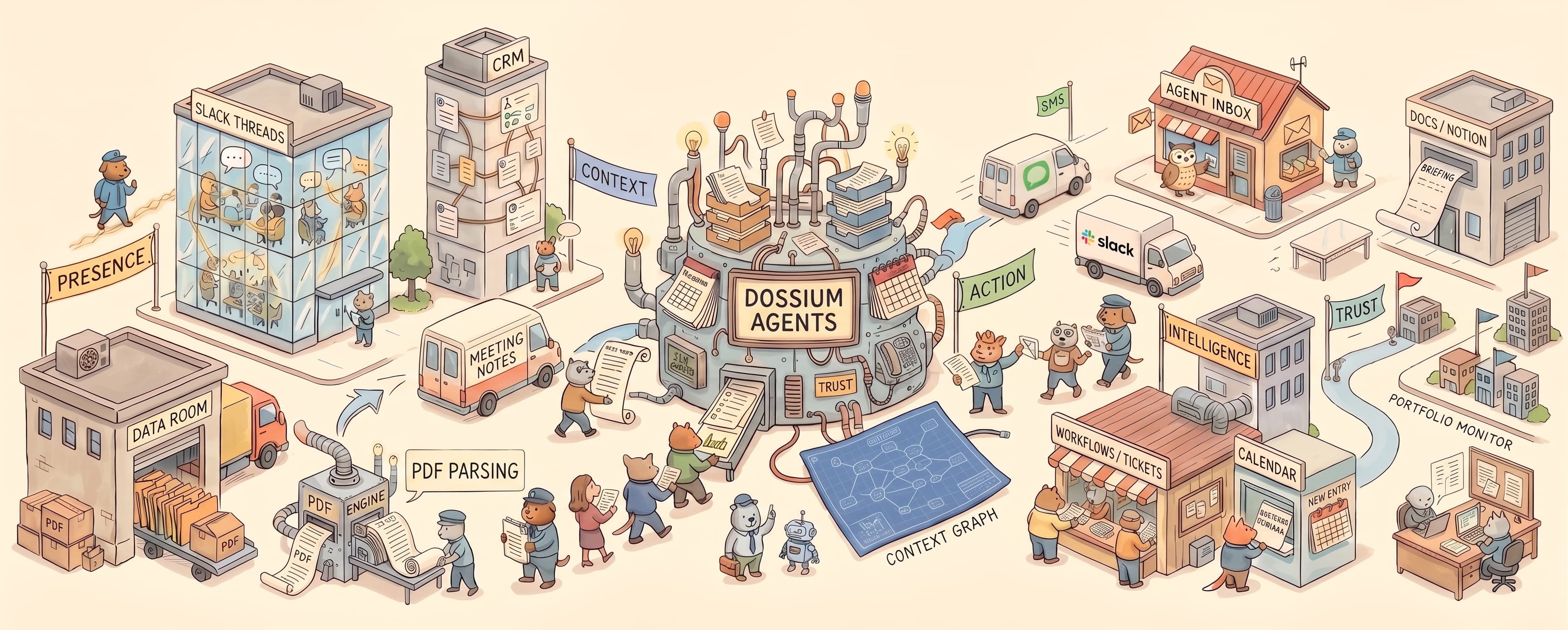

A five-part launch series on the Agent Experience layer for B2B work: context and methodology, channels and persona, governed action, research orchestration, and the runtime that makes agents dependable.
You are walking out of a partner meeting and a portfolio CEO calls. You take it in the cab: twenty minutes about a hire that fell through, a renewal that is wobbling, a competitor announcement they cannot unsee. Walking up to the office, you text your team a summary. By 2pm you are in the Slack thread they opened from your text, hashing out a recommendation. Before you leave, you owe the founder an email confirming what you will do.
That is one conversation. Four surfaces. An hour of your day if you are efficient.
Most agent products on the market today cannot carry that work across surfaces without losing track of themselves. They live in a chat box. The chat box closes. The next surface starts from zero.
This is day two of launch week. Yesterday was about the two kinds of context an agent needs before it can do useful work: operational context and methodology context. Today is about what it takes for an agent to actually live in your work life - to be present where you are, to be the same assistant every time, and to know how your team turns conversation into output.
Three things have to travel with the agent. Where it meets you. Who it is when it gets there. How it does the work.
Channels, persona, skills.
Continuity Is The Product
Dossium reaches you on the surfaces you already work in: voice, Slack, Microsoft Teams, Discord, Telegram, WhatsApp, Google Chat, email, iMessage and SMS, and the web app. Read that as an omnichannel checklist and you have missed the point.
Channel coverage is not the product. Continuity is.
A useful agent should not be trapped in a web app waiting for you to remember it exists. Real work happens in text threads, Slack channels, inboxes, calls, docs, tickets, and calendars. Decisions get made in one surface and followed up in another. A question starts on your phone, becomes a Slack thread, turns into an email, ends as a briefing. If the agent loses itself every time the surface changes, it is not really working with you - it is ten different chatbots, and you are the one stitching them together.
Presence is part of Agent Experience. The transport changes; the identity does not. A brain that only lives in files is useful for agents. A brain that lives in Slack, email, voice, and text is useful for the team.
This matters most in the handoffs. A partner asking for the latest on a company while you walk into the office. A CS lead forwarding an escalation before the QBR. A founder asking for the board-update version of a thread that started in Slack and moved to email. The work is not confined to one surface, so the agent cannot be either.
Continuity Is Not Uniformity
Continuity does not mean the same output everywhere. Every channel has a different social shape, and a teammate who answers email like a text or voice like email is not actually present. They are imposing one channel on every other. The agent has to know where it is before it writes.
Voice - powered by Twilio, Deepgram, and ElevenLabs - should sound like a conversation. Short, direct, no markdown, no caveat stack. If you call the agent from the car, you do not want a memo read aloud. You want the answer you can remember when you park.
Slack can be more structured. If the answer includes companies, owners, risks, or next steps, Dossium renders it as a native table instead of dumping an ASCII grid into the thread. That matters more than it sounds. A deal team should be able to scan an answer on mobile without decoding pipe characters.
Email is for long context. Data room updates, contract attachments, customer threads, forwarded chains, partner notes. The agent understands that replying-all on an investor thread is a different act from answering you privately, and writes accordingly.
iMessage and SMS, powered by Sendblue, look like a person texting you. Short messages. No formatting gymnastics. No paragraphs that feel like they escaped from a browser.
The same assistant adapting to the surface - that is the difference between "we support channels" and "the agent is present where work happens." For a deal team, a quick text becomes a structured Slack readout. For customer success, a forwarded escalation becomes an email-ready QBR note. For leadership, a messy discussion becomes the short version you read between meetings and the long version your team uses later.
An Agent Needs An Address
When you finish onboarding, you get an inbox: username@durableagents.ai, provisioned through AgentMail. Each user in an organization gets their own. You can forward to it, CC it, reply to it, bring it into a thread.
This is one of the simplest product details and one of the most consequential. An agent with an inbox feels like a teammate. An agent without one feels like a chat window. Long-form belongs in email. Data room updates belong in email. Contract attachments, customer escalations, partner follow-ups, investor threads - email is still where serious B2B work lands.
If the agent does not live there, it does not live in your work.
Video Is Company Context
There is a surface that quietly changes what agents can know: video. Forward a podcast clip, share an X post with embedded video, paste a link to a competitor's product demo - Dossium reads across visual frames, audio, and transcript together, powered by TwelveLabs.
So you can ask: What did Jensen say about agents in that keynote? What was the product workflow in the demo I forwarded last week? Did the founder say anything in the podcast that conflicts with the data room? A 40-minute video becomes searchable like a 40-page PDF.
This is not a novelty. For deal teams, customer success, and leadership, important context increasingly lives in recordings: founder interviews, product demos, customer calls, webinars, podcasts, launch videos. Treating those as dead links cedes a meaningful share of company knowledge.
Video is company context now.
Persona Is Judgment, Not Tone
Channels solve where the agent meets you. Persona solves who is meeting you.
During onboarding, Dossium asks what kind of assistant you want: Executive Assistant, Chief of Staff, Operations Partner, Research Analyst, or General Assistant. It asks about tone, initiative level, what to optimize for, and what the agent should do when it is not sure. Then it uses your role, company, and enriched company context from Crustdata to generate a personalized persona.
An investor gets examples about portfolio signals and diligence. A CS lead gets QBRs, renewals, support history, and escalation patterns. A founder or executive gets board prep, partner syncs, investor updates, and company signal. An account exec gets relationship context and deal intelligence.
The mistake here is to think persona is about voice. It is not. Persona is about judgment. A Research Analyst should push for evidence and unresolved questions; if it does not, it is just a polite version of the wrong agent. A Chief of Staff should protect attention and surface decisions. An Executive Assistant should know when brevity matters more than completeness. Those defaults change what the agent does, not just how it sounds.
The result is a SOUL.md file: plain Markdown describing identity, personality, communication style, operating principles, and things the agent should never do. That file travels with the agent - voice at 6pm, Slack at 9am, email overnight - same assistant, same understanding of how you want to work.
The transport changes. The relationship does not.
Skills Are Methodology, Loaded First
Persona makes the agent feel consistent. Skills make its work repeatable.
A deal team does not want "summarize this company." It wants: run our diligence checklist and show the unresolved evidence. A CS lead does not want "summarize Acme." They want: prep the QBR the way our team preps QBRs. A founder does not want "write an update." They want: turn the actual customer, product, hiring, and investor threads into the board-update format we use. The difference is methodology.
In Dossium, a Skill is a Markdown playbook for how work should be done: when to use it, what process to follow, what the output should look like. Customer Briefing. QBR Prep. Escalation Report. Pipeline Digest. Diligence Checklist. Portfolio Review. Board Update.
The important part is where skills live at runtime. A skill is not a document the agent might find in a knowledge base if it remembers to search. Dossium semantically matches the right skills to the run and loads them into the high-attention beginning of the model's context, right after the system prompt - not retrieved on demand, but waiting before the first token.
Operational context tells the agent what is true. Skills tell it how your team turns truth into work.
That is where the product starts to feel different. The agent is not improvising a QBR from generic best practices. It is working from the account history, support threads, usage signal, customer sentiment, and your team's QBR structure. It is not improvising a diligence memo from web search. It is working from your diligence checklist, the data room, the founder interview, CRM notes, and the open questions your partners care about.
Same context graph, different methodology, different output.
Methodology Belongs In Git
We support SOUL.md and SKILL.md because agent identity and methodology should not be locked inside a product UI. The teams getting serious about agents already treat their playbooks the way they treat code: kept in a repo, reviewed, versioned, forked, improved.
Connect a GitHub or GitLab repo and Dossium ingests your team's SKILL.md files as agent methodology. Update a skill in Git, the next run uses the new version. The same files can power Dossium agents, Anthropic Claude Code, Cursor, and other agent ecosystems - which matters, because the market is moving toward portable agent context, identity, and methodology.
Files are useful for methodology. Operational reality needs a live graph. Dossium brings them together: files for how, graph for what, agents on top.
If you leave Dossium, your persona and your playbooks come with you in plain text. That is the right default for a teammate.
Tomorrow
Today was presence, persona, and methodology. Tomorrow is action.
Reading is half the agent. Writing is the other half. We will go into the distribution layer: Slack, Notion, Linear, Jira, Google Docs, Microsoft Word, Gmail, Outlook, calendar, social, CRM, and support systems. Why "send an email" should not require the agent to choose Gmail or Outlook. Why read access and write access need different trust tiers. Why the output belongs in the work system, not trapped in chat.
Getting Started
If you want to feel continuity in practice, start the agent in the terminal, then use its real channels.
Sign up at dossium.ai. Text the agent from your phone. Forward it a video. CC its inbox on a thread. Open Slack and ask it the same question you texted from your car.
Same agent. Same persona. Same memory.