
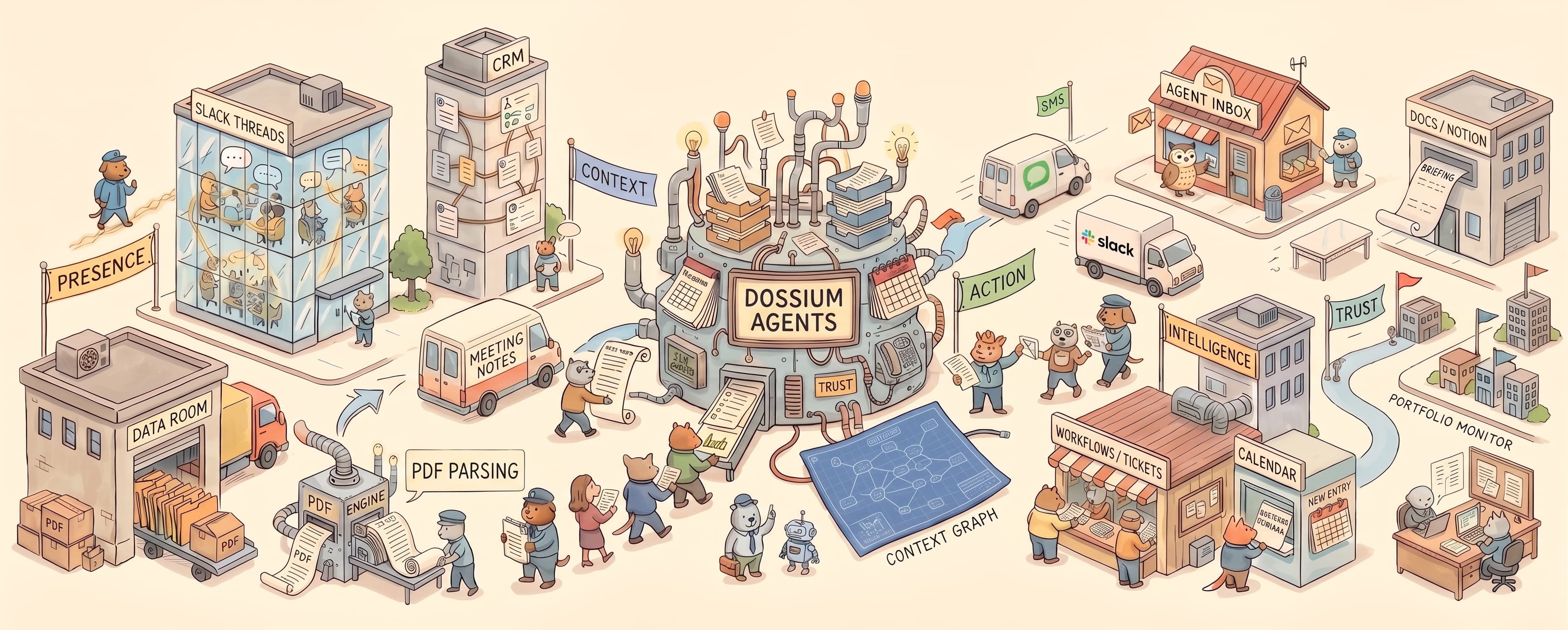

A five-part launch series on the Agent Experience layer for B2B work: context and methodology, channels and persona, governed action, research orchestration, and the runtime that makes agents dependable.
You asked the agent: what changed since our last review? Eight minutes later you have the briefing - the data room update, the unresolved questions, the customer reference that does not track with the growth story.
Now you have to put it somewhere. The deal team channel in Slack. The investment memos page in Notion. An email to the partners walking in. A follow-up note in the deal record so the next reviewer sees it.
Four destinations, four different shapes of work - and in most products on the market today, none of them are the agent's job. The chat response finishes, the routing falls back to you.
That is what we mean by distribution. It is the second half of an agent, and it is the half most products still hand back with a copy button.
This is day three of launch week. Day one was context and methodology. Day two was presence: same agent, every surface. Today is about action.
A company brain that cannot act is still a reference system.
The Closed Loop
The agent's job is a three-step loop: read state, decide what matters, act on it. Most products do the first two well and stall at the third. A diligence readout that never makes it into the deal team's Slack channel did not really become work. A renewal risk that never becomes a ticket is not tracked. A board-prep answer that never becomes the draft update stays trapped in chat.
The destination is not an afterthought. It is the work product.
This is where Dossium is different from workflow automation. Workflow automation starts from a known trigger and a known action: when this happens, do that. Dossium starts from context - the agent reads the state of the business, decides what work needs to happen, then routes that intent through governed write paths.
The right action is sometimes post this, sometimes draft this, but ask before sending, sometimes nothing changed; do not create noise. The action is downstream of understanding, not prewired around it.
Agents Should Express Work Intent
Most agent platforms expose provider-specific tools to the model: a separate function for sending Gmail and another for Outlook, separate tools for Notion pages and Confluence pages, separate Linear and Jira issue creators. The model has to pick the right tool, understand the provider, know which account is connected, and avoid choosing one the user cannot actually use.
That is the wrong level of abstraction.
The agent should describe the work. The platform should route the provider.
In Dossium, the agent says things like send an email, write a document, create or update an issue, schedule a meeting, post to a channel, draft instead of send, add a note to the CRM. Dossium maps that intent to the user's connected systems and permissions.
"Send an email" should not require the agent to know whether you use Gmail or Outlook. "Write a briefing" should not require it to know whether the destination is Notion, Confluence, Google Docs, Microsoft Word, Drive, OneDrive, or SharePoint. "File the escalation" should not require it to care whether your team tracks work in Linear, Jira, Zendesk, or Intercom.
The model describes the work; the platform handles provider routing, OAuth state, provider quirks, and error handling. That is Agent Experience applied to tools - one clean work verb, not a maze of provider-specific APIs.
The Work Primitives
Most business systems reduce to a small set of actions.
Create is a new page, issue, event, or draft.
Replace updates the status, title, date, owner, or body of something that exists.
Append adds a comment, reply, running memo entry, or note on an account.
Upsert ensures the thing exists and updates it if it does.
Delete cancels, removes, closes, or archives when the user has explicitly asked.
The point is not the vocabulary; the point is portability. A diligence skill can say "append open questions to the investment memo" without caring whether the memo lives in Notion, Confluence, or Google Docs. A QBR skill can say "append follow-ups to the running customer notes page" without caring which document system the team uses. An escalation skill can say "create a triage ticket" without caring whether the team runs Linear, Jira, Zendesk, or Intercom.
The methodology describes the work. Dossium resolves the destination.
What This Looks Like By Role
For a deal team, distribution means diligence work does not end as a chat transcript. The agent posts unresolved questions to Slack, drafts the partner memo in Notion or Google Docs, adds follow-up tasks to Linear or Jira, and emails the deal team before the meeting.
For customer success, distribution means QBR prep becomes tracked work. The agent writes the customer briefing, appends notes to the account record, drafts the follow-up email, and creates a ticket for the support issue that keeps showing up across calls.
For leadership, distribution means board prep does not stay in the assistant window. The agent turns internal threads, customer signal, product changes, and investor emails into a draft update your team can edit.
For support, distribution means escalation patterns become action. The agent summarizes incident history, files or updates the ticket, and posts the account context where the support lead is already coordinating.
For account executives, distribution means call prep becomes follow-through. The agent drafts the account brief, adds the CRM note, schedules the follow-up, and sends the recap after the call.
The principle is the same across roles: the answer belongs where the next human will use it.
Human Names, Not System IDs
Agents should speak like humans. Post this in #deal-review. Save it to the Diligence Briefs folder. Add it to the Investment Memos database. Put this in the Customer Success team's backlog. DM Sarah on Slack.
The agent should not need to know a Slack channel ID, a Notion database ID, a Linear team UUID, a Jira project key, or a Drive folder ID. Those identifiers are plumbing, and people do not work that way. Dossium resolves friendly names to provider IDs before writing. If the name is ambiguous, the platform asks the user to choose instead of letting the model guess.
That choice should look native to the surface: a selector in Slack, a picker in the web app, a numbered reply over SMS. Same decision, different presentation, human judgment where ambiguity matters.
Read Access And Write Access Are Different
This is the part serious B2B users care about. Agents that can act need trust boundaries, and most integrations treat connection as binary: either the product has access to Notion or it does not, either it can read the account or it can write to the account.
Dossium separates those grants. Context-only connectors let the agent ingest and retrieve content as grounding - the agent can read enough to reason. Delivery connectors let the agent create, replace, append, draft, send, or delete - the agent can change the systems where work lives. Those are different categories of trust.
You may want Dossium to read your Google Workspace before you want it sending mail. You may want Linear context before you let the agent file issues. You may want Notion retrieval before you let an agent create pages in a workspace. That should be your call, provider by provider.
This is why pre-connection matters. Scheduled and triggered agents often run when no human is sitting there to approve OAuth. A 7am portfolio monitor cannot stop and ask someone to authorize Slack delivery. A renewal-risk watcher cannot discover at the end of the run that it has nowhere to file the ticket. You connect the accounts ahead of time, choose the trust tier, and decide where each agent is allowed to deliver. Then the run can do real work.
Targets Make Automation Useful
Agents can have default destinations. A Portfolio Monitor posts to #portfolio-updates every weekday morning. A Weekly QBR Prep agent writes to the Customer Briefings database. A Renewal Risk Watcher files into the Customer Success team's triage queue. A Deal Prep agent drafts an email to meeting attendees one hour before the call.
That is what makes scheduled and triggered agents useful. A run with no human in the loop cannot ask "where should I put this?" at the end. The destination needs to be configured before the work starts.
Targets do not remove judgment; they remove friction. The agent still decides whether anything matters. The platform already knows where the output belongs if it does.
The Safety Nets
Agents can act. They cannot run wild. Dossium has three safety patterns around distribution.
Drafts before sends matter when the agent knows what to write but should not send yet. The user reviews, edits if needed, and hits send.
Side-effect budgets mean a single run cannot turn into fifty Slack posts, twenty tickets, or a burst of accidental emails. Write actions are capped at the runtime layer, not left to the model's good behavior.
Organization-level rate limits stop the blast radius at the org boundary if a trigger is misconfigured or a loop starts.
The contract is simple: enough power to be useful, enough boundaries to be trusted.
Coming Next
Pre-connected delivery works today. You connect the accounts, choose context-only or delivery, and configure targets for the agents that need them.
The next step is click-to-OAuth from inside a run. If an agent wants to create a Notion page but you have not enabled Notion delivery yet, it should be able to say: I can do this, but I need permission first. You click, OAuth happens outside the agent runtime, the permission is established, and the run resumes.
The agent does not handle OAuth. It requests permission, the human grants it, the platform resumes the work.
That is the right shape.
Tomorrow
Distribution closes the loop. Tomorrow is about the intelligence layer behind it: how the agent decides what evidence matters and where to look.
How does an agent know which evidence to gather? How does it decide when internal context is enough, when web research is needed, when enrichment matters, and when a question should split into multiple workers? Real research is not one search against one index. We will go into analyze_prompt as the routing brain, internal retrieval as a peer to the web, Crustdata enrichment and Signals, Parallel research, research_plan, and how workers decompose by analytical lens.
Getting Started
Take the agent output you copy-paste most often - the deal note, QBR follow-up, escalation ticket, or board-prep draft - and make that the first delivery target.
Sign up at dossium.ai. Connect what the agent can read, connect where it can write, and pick the trust tier you are comfortable with for each provider.