
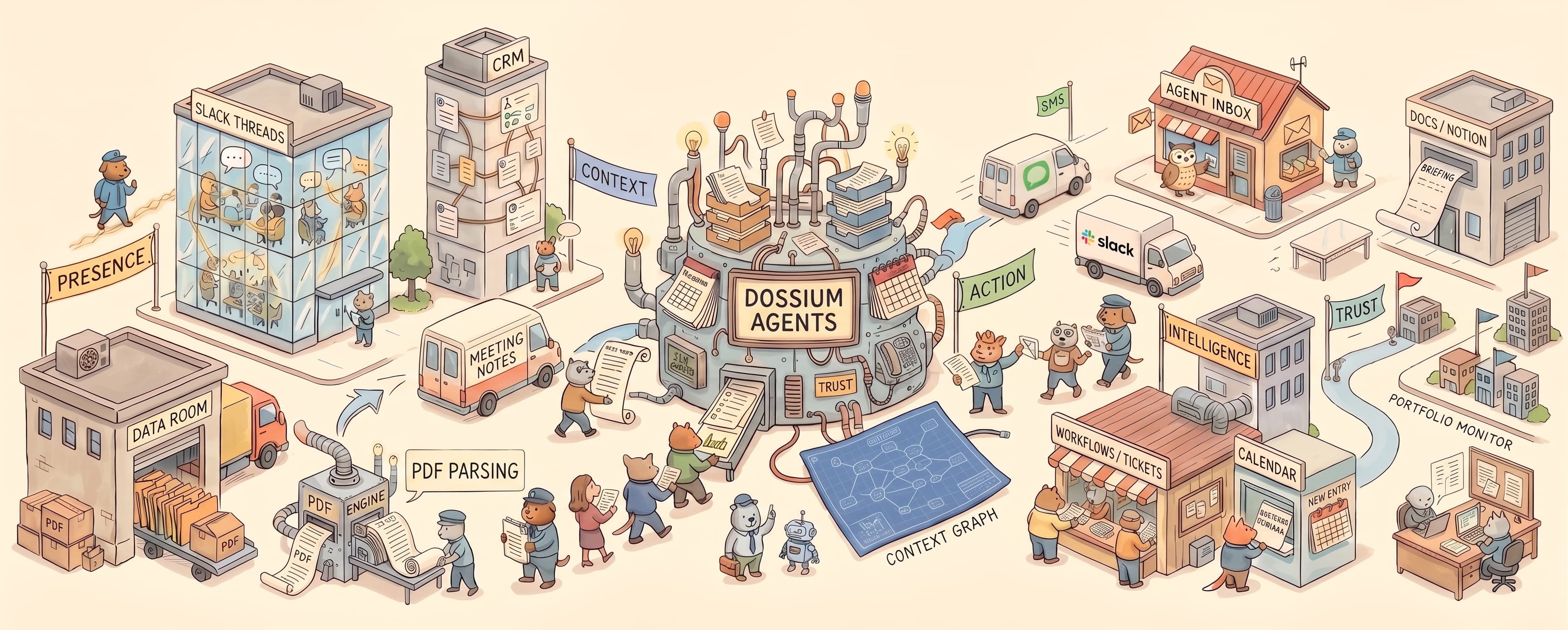

A five-part launch series on the Agent Experience layer for B2B work: context and methodology, channels and persona, governed action, research orchestration, and the runtime that makes agents dependable.
You are going into a partner meeting in ninety minutes. Two companies are on the agenda. One has a fresh data room update, a founder podcast from last week, three old CRM notes, and a customer reference that does not quite match the growth story. The other has a quiet board thread, a hiring spike, and one support escalation that never made it into the memo.
You text your agent:
What changed since our last review?
Most agent products start from that sentence and go hunting. Search Slack. Search docs. Search the CRM. Search the web. Return fragments. Maybe cite them. Maybe miss the thing that mattered because the evidence lived across five systems and none of them was authoritative alone.
Dossium starts differently.
Dossium is not more connectors.
Connectors are the sensors. Dossium is the agent layer that turns company memory into work.
Before the first token, the agent already has a context graph of your work: people, companies, content, conversations, facts, commitments, relationships, timelines, source provenance, and external signal. Data-room PDFs have been extracted into Markdown. Meeting transcripts have been indexed. Slack threads have become evidence. Public web signal has already been warming up.
It has your persona. It has your methodology. It knows which channels it can use and which systems it can write to. It knows what it is allowed to do.
The answer is not useful because magic happened. It is useful because the run did not start from zero.
That cold start is the problem most agents still hand back to the user. The chat box loads. The model has no idea who you are, what your team does, what you decided last week, which source is stale, or where the result should go. It can call tools, but the context, methodology, delivery surface, and judgment about what matters all live in your head.
If you have tried the current agent stack - general-purpose agents, workflow builders, company-brain tools, connector layers, maybe all of them - you know the pattern. The agent can call tools. It can retrieve documents. It can summarize a thread. Then the real work starts, and you spend the next twenty minutes teaching it the company.
The question is not whether agents can call tools.
The question is whether an agent can experience your company well enough to do real B2B work.
Not just access it.
Experience it.
Today we are shipping Dossium Agents. This is day one of launch week.
UX, AX, and the Company Brain
UX is how humans experience software.
AX is how agents experience the company.
That is the layer we are building with Dossium: the Agent Experience layer for B2B work.
The market is starting to call part of this a company brain. I think the phrase is directionally right. Companies do need memory. They need a living model of customers, deals, projects, decisions, commitments, support history, meeting context, investor updates, and external signal.
But a company brain that only remembers is not enough for agents.
Agents need memory, but they also need methodology. They need channels. They need governed action. They need a runtime that can keep working after the chat response ends. They need boundaries. They need a way to ask for help, write safely, and come back to the same Slack thread an hour later with the result.
Connectors give agents access. A context graph gives them memory. Skills give them methodology. Channels give them presence. Distribution gives them hands. Runtime gives them discipline.
That is Dossium Agents.
Two Kinds of Context Agents Need
There are two kinds of context that turn an LLM into an agent. Most products handle one. Many handle neither.
Operational context. Which portfolio company opened six senior AI roles this month. What the customer said in the last QBR. Which investor update mentioned churn risk. Whether the CRM, the signed contract, or the latest call transcript should win when they disagree. The state of the world your agent is reasoning over: identity-resolved, time-aware, source-grounded, multimodal.
This is the WHAT layer.
Methodology context. The way your team writes an investment memo. The way you prep a QBR. The way you classify an escalation. The way you turn a board thread into an investor update. The repeatable shape of how work gets done.
This is the HOW layer.
These are independent. Operational context with no methodology is enterprise search. Methodology with no operational context is a clever prompt template. An agent needs both, loaded into the model the moment a run starts.
Company memory tells the agent what is true. Methodology tells it how your team turns truth into work.
RAG Is Not Dead. RAG Is Everywhere.
The market keeps declaring RAG dead. RAG is not dead. RAG is everywhere.
Retrieving content. Retrieving communications. Retrieving entities. Retrieving facts. Retrieving from the public web. Retrieving from meeting transcripts. Retrieving from prior conversations with the agent. Retrieving the right skill for the task. All of it is retrieval-augmented generation.
The mistake is not using RAG. The mistake is treating RAG as one tool call against one index.
Real B2B work has a hundred retrieval surfaces. A diligence pass on a company involves the data room, customer calls, partner notes, the CRM, support history, public news, LinkedIn profiles, podcast transcripts, and your team's prior conversations. A QBR involves usage trends, renewal terms, support tickets, Slack threads, meeting transcripts, open commitments, and sentiment over time. A board update involves investor emails, product decisions, sales objections, roadmap changes, and weak signals that never became dashboard metrics.
Every one of those is retrieval. Every one of them is RAG.
But retrieval cannot be a scavenger hunt from zero every time. The point is to build and maintain a context graph so the agent is not rediscovering the company on every run.
Dossium is built on Graphlit, our context platform. Graphlit ingests multimodal work, extracts entities and facts, resolves identity, preserves provenance and time, and organizes the result into a collaborative context graph. Dossium puts agents on top of that graph.
Data model first. Agents second.
Connectors Are Sensors
The connectors matter, but not because more logos equal more intelligence.
Connectors are sensors. They are how the company speaks.
Slack threads, emails, calendar events, meeting recordings, docs, support tickets, CRM records, GitHub issues, Linear tasks, Notion pages, Jira projects, data rooms, transcripts, and public web signal all carry fragments of reality. The product is not that Dossium connects to them. The product is what Dossium builds from their signal.
People become resolved entities instead of five spellings across Slack, email, CRM, and transcripts. Companies accumulate timelines. Facts become commitments, decisions, escalations, changes, goals, and open questions. Conversations become evidence. External signal becomes part of the same graph as internal work.
This is the difference between access and understanding.
Access means an agent can reach your data.
Understanding means the agent knows what that data means in the context of everything else.
Workflow builders and connector layers are important. They gave agents hands. But hands without a model of the business mostly move fragments around. Dossium starts one layer earlier: ingest the signal, extract the structure, resolve the entities, preserve time and provenance, then let agents consume that graph through retrieval tools, skills, channels, and governed write paths.
Connectors are the sensors. The context graph and AX layer are the product.
The Onboarding Moment
You sign up. You tell us three things: your name, your company, your role.
Behind the scenes, several things happen at once.
Crustdata enriches your company in real time: industries, headcount, headquarters, LinkedIn URL. We pull a public profile sketch for you. Parallel Web Systems begins indexing news and Reddit threads about your company. Crustdata Signal feeds light up: funding rounds, job postings, news mentions, profile updates you will want to know about. Perplexity provisions a competitive landscape feed. Podscan watches for podcast mentions.
None of this requires you to connect a single internal tool. Within seconds of typing your company name, the external signal layer is already warming up.
Then we ask how you want to be helped: Executive Assistant, Chief of Staff, Operations Partner, Research Analyst, or General Assistant. Tone. Initiative level. Primary optimization. Uncertainty policy.
We take that and generate a personalized SOUL.md persona for you. Two parallel LLM calls run: one fills in domain knowledge specific to your industry and role; the other writes a personality-forward intro and three example prompts tailored to your company.
Two agents are provisioned automatically. A messaging agent that lives on iMessage and SMS. An email agent with its own AgentMail inbox at username@durableagents.ai. Both attached to your persona. Both ready before you finish onboarding.
Then we hand you a phone number and ask you to text it.
That is the moment. You text your agent before you have connected everything else. And it already knows your name, your company, your role, your industry, and how you want to be talked to.
Not a blank chat box.
An agent with an experience of you and your company from the first run.
Five Ways To Wake Up
Dossium Agents come in five activation modes.
Chat agents are conversational. You message them on iMessage, Slack, voice, email, or web. They respond inline with full context. Use case: a deal team agent that answers "what changed in this company's story since our last partner meeting?" in eight seconds.
Scheduled agents run on cron. 7am every weekday. First Monday of the month. Whenever you specify. Use case: a Portfolio Monitor that walks your priority companies every morning and posts a digest before partner meeting prep starts.
Triggered agents fire on content events: a new data room file lands, an email arrives, a Slack thread escalates, a CRM record changes. Use case: an Escalation Watcher that wakes up the moment a customer mentions "legal," pulls their history, and posts a triage note to your team channel.
Webhook agents activate on external POSTs with per-agent token authentication. Use case: a Deal Prep agent that fires when your CRM marks a meeting as upcoming, pulls everything about the company from the last six months, drafts a briefing, and emails it to attendees an hour before they walk in.
Heartbeat agents run continuous probes during your active hours: lightweight checks for changes in your data, well under half a second per check. Use case: a Pulse agent that flags a portfolio signal, renewal risk, or support anomaly the moment it appears, not when someone notices three days later.
Same agent runtime, five different ways to wake up.
Same Agent, Every Surface
The agent reaches you on the surface you already use.
Voice with Twilio, Deepgram, and ElevenLabs. Slack with native table blocks. Microsoft Teams. Discord. Telegram. WhatsApp. Google Chat. Email with AgentMail. iMessage and SMS with Sendblue. Web chat in the Dossium app.
Same persona on every surface, with channel-appropriate rendering. Voice strips markdown and limits responses to three sentences. Slack renders tables natively. Email writes prose with attachments. Messaging splits long responses into separate texts. The agent knows what each channel can hold and writes for it from the first token.
There is a multimodal capability worth calling out specifically. Share an X post with an embedded video with the agent, and Dossium reads the whole thing: visual frames, audio, transcript. When you ask "what did Jensen say at GTC about agents?", the agent searches inside the video, not just the title and description.
A 40-minute keynote becomes searchable like a 40-page PDF.
Methodology Is A First-Class Entity
This is the HOW layer.
A Skill in Dossium is a markdown document with three sections: when to use it, how to do the work, what the output should look like, plus YAML frontmatter for metadata. It is stored as a separate Graphlit entity, semantically matched to the agent's prompt at runtime, and injected into context right after the system prompt.
Methodology is not buried in a knowledge base the agent might search if it remembers to. It is loaded into the high-attention beginning of the model's context window on every run.
We support the SOUL.md and SKILL.md formats popularized by Anthropic Claude Code and OpenClaw. Connect a Git repo and Dossium ingests your team's playbooks as Skills. Update a skill in Git, the next agent run picks up the new version. Your methodology stays in your repo: versioned, forkable, portable.
Files are useful for methodology. Operational context needs a live graph.
Dossium supports both.
Action, Not Just Memory
A company brain that cannot act is still a reference system.
Dossium agents can write back into the systems where work happens: Slack, Notion, Linear, Jira, Confluence, Google Docs, Microsoft Word, Gmail, Outlook, calendar, social, CRM, and more.
The agent does not need to choose gmail.send versus outlook.send. It calls send_email. The platform routes based on the user's connected accounts and permissions. It does not need to know whether a brief belongs in Notion, Google Drive, OneDrive, or Confluence. It describes the work; the platform resolves the provider.
Read access and write access are separate trust tiers. Context-only connectors let Dossium ingest and retrieve. Delivery connectors let agents create, replace, append, draft, or send. You can connect a system for context without granting write access.
Agents can act.
They cannot run wild.
What Is Under The Hood
Dossium agents read from and write to the systems your team already uses. The partner names matter because each one covers a specific part of the work loop: signal, context, synthesis, delivery, durability.
Crustdata gives the agent firmographics, people enrichment, and Signal feeds. Parallel Web Systems gives it company research and broad web search at agent-run speed. Perplexity handles competitive synthesis when raw links are not enough. Tavily and Exa cover general web retrieval. Podscan turns podcasts into a searchable source of executive signal.
The internal work graph comes from the systems teams already live in: GitHub, GitLab, Linear, Jira, Confluence, Notion, Asana, Monday, Google Workspace, Microsoft 365, Slack, Teams, Discord. CRM through HubSpot, Salesforce, and Attio. Support through Intercom, Zendesk, and Productlane. Meetings through Fathom, Fireflies, Zoom, and Krisp. HRIS through BambooHR and Gusto. Storage through Cloudflare R2, Backblaze B2, DigitalOcean Spaces, and Wasabi.
Data-room PDFs deserve their own mention. Reducto is our default partner for PDF extraction to Markdown, which means the twenty-page operating plan or legal appendix in the data room becomes structured agent-readable context instead of an opaque file blob the model has to interpret later.
The runtime is its own layer. Anthropic for the models, with prompt caching enabled by default. Upstash QStash for scheduling. Vercel Workflows for durable execution. Upstash Redis for operational state. Clerk for auth. Brandfetch for partner logos.
Forty-plus integration partners and growing.
Not a logo wall.
The substrate.
The Rest Of Launch Week
I will break the platform open one layer at a time.
Tuesday: channels, persona, and methodology. How one agent reaches you across ten surfaces, why it sounds like the same assistant everywhere, and how SOUL.md / SKILL.md make methodology portable.
Wednesday: distribution. Write paths to a dozen-plus providers, provider-agnostic verbs, pre-connected OAuth, trust tiers, target resolution, and why "send an email" should never require the agent to choose Gmail or Outlook.
Thursday: research. analyze_prompt as the routing brain, internal retrieval as a peer to the web, Crustdata enrichment and Signals, Parallel research, research_plan, and workers decomposed by analytical lens.
Friday: runtime. Vercel Workflows, Upstash QStash, prompt caching, pre-check probes, harness controls, and the decisions that keep multi-hour agents from going off the rails.
Context. Presence. Action. Intelligence. Trust.
That is launch week.
Getting Started
If you want to feel what Agent Experience means in practice, the fastest path is to text the agent.
Sign up at dossium.ai. Pick your role, drop your number into the wizard, and text the agent the same thing you would ask a teammate:
What changed since our last review?
It texts back inside two minutes, already knowing who you are, what your company does, and how you want to work.